2026年聯合國世界濕地日的主題是「濕地與傳統知識:傳承文化遺產」,旨在探討世界各地社區的濕地與文化習俗、傳統和知識體系之間根深蒂固的聯繫。在這個主題的號召之下,我們將重新檢視自然公園的濕地環境在當代的語境之下能夠扮演角色與思考。這個也意謂著我們將回歸關渡自然藝術季在策展主體性上,能夠開展出有更進一步的詮釋空間與思考的可能性。
在去年2025年的年度主題展「看見關渡,自然作為一個解方」中,「看見」這個姿態除了回顧過往藝術季脈絡之外,也有關渡作為「地方」的文化景觀的雙重意義。我們常把10年作為一個世代的指稱,已走過20年的關渡自然藝術季,我們將回看過往的文化遺產的並聚焦這個主軸,試圖規劃出三年的策展計畫。第一年我們將從「神話」這個文化概念出發,探索自然在神話這個語境下的意義,作為重新審視人與自然關係一個開端。
在18世紀德國唯心主義的哲學家謝林(Schelling1775-1854 )的自然哲學中認為,神話並非謊言,而是人類心靈與自然力量共鳴的產物,反映了人與宇宙本體之間最初的統一關係,謝林將神話視為一種「原始的詩歌」或「真實的符號」,是人類心靈在自然中感受到的神聖啟示,是人類精神在意識尚未完全覺醒時,直接感應到自然中的神性與力量,並將其外化、具象化為神的故事,是人類意識從潛意識走向自我意識發展過程中的必然產物,神話用故事的形式,捕捉了自然界中那些難以用邏輯窮盡的「生命力」與「創造力」。而當代對神話這項文化遺產的運用,也影響了當代的生態哲學的發展。1972年,當英國科學家詹姆士洛夫克洛(James Ephraim Lovelock)提出的蓋亞假說(Gaia Hyphothesis)強調環境與生命共同建構的概念,無疑是借用了神話中蓋亞作為大地之母中諸神起源與創造性的能力。無論如何,神話一直存在我們的語境當中,關渡作為早期臺北盆地入口的地理位置與環境,從而匯聚了各種文化與生活型態的交疊,從凱達格蘭族的原民文化到渡海來台的漢族文化,從採集漁獵到農漁業的生活型態乃至現代生活的演化,關渡一直擁有豐富的文化脈絡,以關渡宮這個北部最早的媽祖廟為例,正是以宗教的方式,來展現早期人與自然關係。
法國的符號學哲學家羅蘭巴特(Roland Gérard Barthes1915—1980 )更指出,神話的作用是「賦予意義」。它將一個具體的對象轉化為一個抽象概念的載體 。因此,2026年的策展主題為「神話棲地:濕地上的眾神絮語」,策展將聚焦於神話與自然的關係。無論如何,不管是從不同文明中與遠古的自然與神話傳說的再詮釋,或是將當代生態與氣候變遷敘事的再神話或是取徑於關渡地區的地理環境與文化脈絡,自然的神話化(Mythologization)將引領我們回到遠古時代的人類心靈,找尋那些被現代文明劫持、卻從未消失的原始靈性。
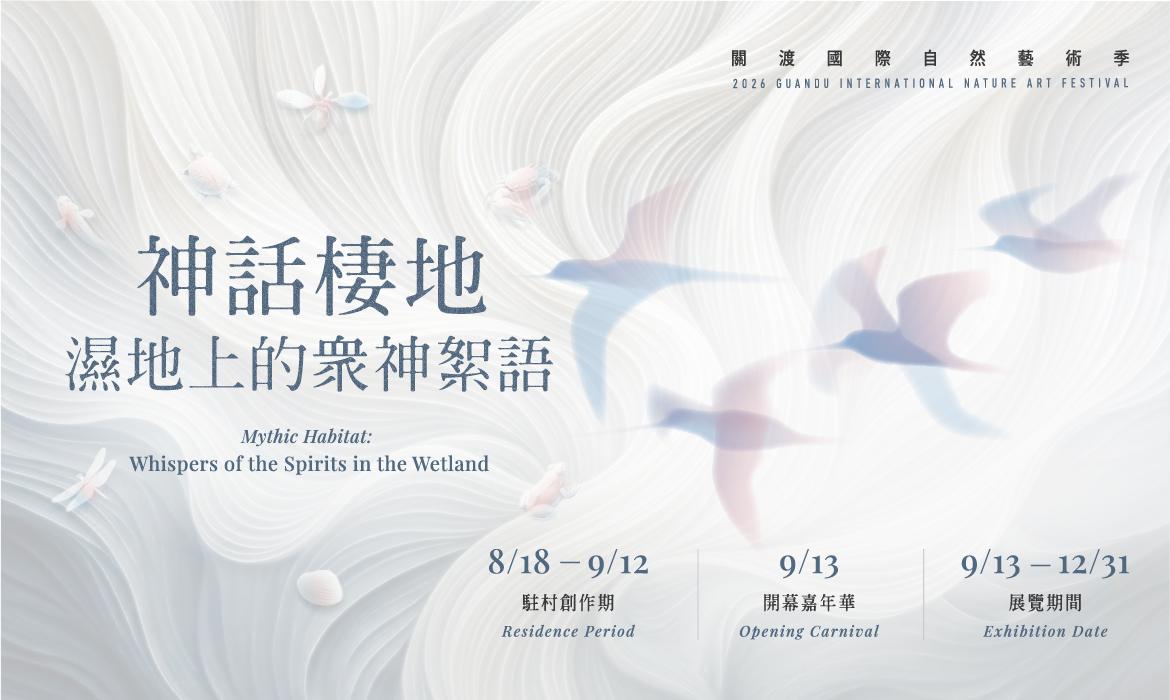
本屆2026策展主題《神話棲地:濕地上的眾神絮語》將聚焦於神話與自然的關係。期待藝術家能結合關渡自然公園的濕地景觀與自然環境,從不同文明與遠古中所蘊含的自然與神話傳說,或是取徑於關渡地區的地理環境與文化脈絡中神話元素的再詮釋,以及將當代生態與氣候與環境變遷敘事的以神話形式表現,展現自然與神話中特有的想像力與生命力,展現人與自然在心靈上的關係。
World Wetlands Day 2026, under the theme “Wetlands and traditional knowledge: Celebrating cultural heritage,” explores the deep-rooted connections between wetlands and the cultural practices, traditions, and knowledge systems of communities around the world. In response to this global call, we are re-examining the role that the wetland environment of Guandu Nature Park can play in a contemporary context. This also marks a return to the distinctive curatorial perspective of the Guandu International Nature Art Festival, opening up new possibilities for interpretation and reflection.
In the 2025 thematic exhibition, Seeing Guandu: Nature as a Solution, the act of “seeing” carried a dual significance: it not only revisited the Festival’s trajectory but also brought into focus Guandu’s cultural landscape as a “place.” A decade is often regarded as a generation. Having completed two decades, the Guandu International Nature Art Festival will now revisit its cultural legacy and make it the central thread of a three-year curatorial initiative. The inaugural year begins with “myth” as a cultural concept, exploring the significance of nature through a mythological lens as a point of departure for re-examining the relationship between humanity and nature.
In the Naturphilosophie (philosophy of nature) of the 18th-century German Idealist philosopher Friedrich Wilhelm Joseph Schelling (1775–1854), myth is not a falsehood but arises from a resonance between the human psyche and the forces of nature. It reflects the primordial unity between humanity and the cosmos. Schelling regarded myth as a form of “primordial poetry” or a “true symbol”—a divine revelation experienced by the human psyche in nature. For Schelling, before consciousness fully awakens, the human spirit directly perceives the divinity and power inherent in nature, externalizing and giving tangible form to these forces in stories of the gods. Myth thus emerges as an inevitable product of human consciousness as it develops from an unconscious state toward self-consciousness. Through narrative, myth captures the “vitality” and “creativity” of the natural world—forces that logic alone can never fully encompass.
This cultural heritage continues to shape contemporary ecological philosophy. In 1972, when British scientist James Ephraim Lovelock proposed the Gaia Hypothesis, emphasizing the mutually constitutive relationship between life and the environment, he unmistakably drew upon the mythological archetype of Gaia—Mother Earth, progenitor of the gods, and embodiment of creative power. Myth has always been woven into our cultural discourse. As the historic gateway to the Taipei Basin, Guandu has long been a confluence of diverse cultures and ways of life—from the Indigenous culture of the Ketagalan people to that of Han settlers who crossed the sea to Taiwan, and from foraging, fishing, and hunting through farming and fisheries to modern urban life. Guandu Temple, the oldest Mazu temple in northern Taiwan, stands as a prime example of how religion gave expression to the early bond between humanity and the natural world.
The French semiotician and philosopher Roland Barthes (1915–1980) further noted that the function of myth is to “endow with meaning”—to transform a concrete object into a vehicle for an abstract concept. The 2026 curatorial theme, “Mythic Habitat: Whispers of the Spirits in the Wetland,” centers on the relationship between myth and nature. Whether through reinterpreting ancient nature myths and legends from different civilizations, recasting contemporary narratives of ecology and climate change in mythic form, or drawing inspiration from Guandu’s distinctive geographical setting and cultural fabric, the “Mythologization of Nature” will guide us back to the ancestral human spirit in search of the primordial spirituality that, though held captive by modern civilization, has never truly vanished.
The 2026 curatorial theme, “Mythic Habitat: Whispers of the Spirits in the Wetland,” centers on the relationship between myth and nature. We invite artists to engage with the wetland landscape and natural environment of Guandu Nature Park by reinterpreting ancient nature myths and legends from diverse civilizations, drawing upon mythological elements embedded in Guandu’s distinctive geography and cultural context, or recasting contemporary narratives of ecology, climate change, and environmental transformation in mythic form—thereby giving expression to the unique imaginative power and vitality inherent in nature and myth and illuminating the spiritual bond between humanity and the natural world.